In modern enterprise environments, network infrastructure is no longer just a support function but a critical enabler of business continuity, performance, and scalability. One of the most overlooked aspects of this infrastructure is the cabling system that forms the backbone of all communication. While many organizations continue to operate on legacy or traditional cabling setups, the limitations of such systems become increasingly evident as data demands grow and technologies evolve.
Traditional cabling approaches were typically deployed with short term requirements in mind. Over time, incremental additions and modifications create a fragmented network architecture that lacks standardization. This results in inconsistent performance, higher attenuation, and increased susceptibility to electromagnetic interference. As bandwidth intensive applications such as cloud computing, unified communications, and high resolution video become standard, these limitations directly impact user experience and operational efficiency.
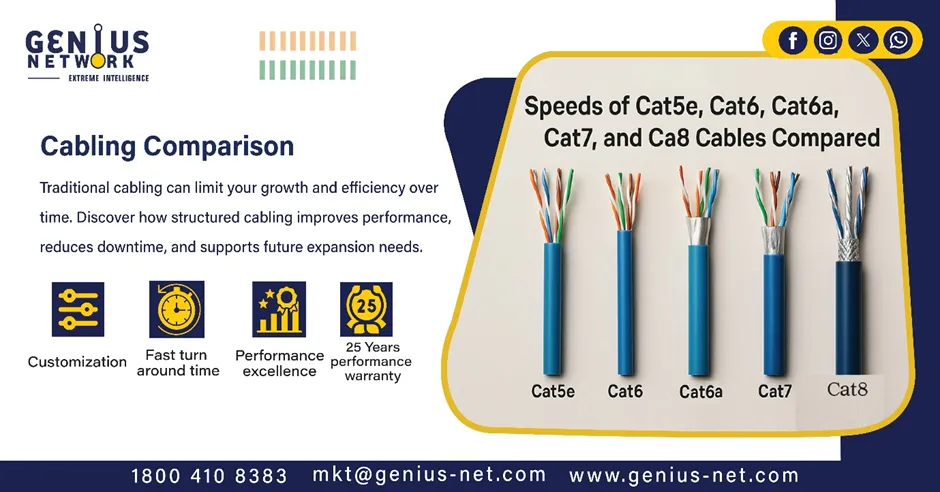
A key area of concern lies in cable category performance. Legacy systems often rely on Cat5e or lower grade infrastructure, which may support basic gigabit speeds but struggle under higher throughput requirements. In contrast, modern structured cabling systems incorporate higher category cables such as Cat6, Cat6a, Cat7, and Cat8, each designed to handle progressively higher data rates and frequencies. For instance, Cat6 supports up to 10 Gbps over shorter distances, while Cat6a extends this capability across standard enterprise distances with improved shielding and reduced crosstalk. Cat7 and Cat8 further enhance performance by offering superior shielding and support for high speed data center environments.
Structured cabling introduces a systematic and standards driven approach to network design. It organizes the cabling infrastructure into logical subsystems, including horizontal cabling, backbone cabling, and centralized distribution points. This structured approach not only improves physical organization but also simplifies network management. Moves, additions, and changes can be executed with minimal disruption, which is critical in dynamic business environments.
From a performance standpoint, structured cabling ensures predictable and reliable data transmission. High quality materials, controlled installation practices, and adherence to international standards significantly reduce signal degradation and interference. This leads to improved network uptime and consistent throughput, which are essential for mission critical applications.
Downtime reduction is another major advantage. In traditional setups, identifying and isolating faults can be complex and time consuming due to the lack of labeling and organization. Structured cabling systems incorporate clear documentation and standardized layouts, enabling faster troubleshooting and reduced mean time to repair. This directly translates into improved operational continuity and reduced business risk.
Scalability is where structured cabling delivers long term strategic value. As organizations expand, the network must accommodate additional users, devices, and applications. Traditional cabling often requires extensive rework to support such growth. In contrast, structured cabling is designed with future expansion in mind. Higher category cables and modular design allow seamless upgrades without overhauling the entire infrastructure.
Additionally, factors such as customization, faster deployment timelines, and extended performance warranties contribute to the overall value proposition. A well designed structured cabling system not only meets current requirements but also aligns with future technology roadmaps, ensuring longevity and return on investment.
In conclusion, the transition from traditional cabling to structured cabling is a necessary evolution for organizations aiming to remain competitive in a digital first world. By leveraging higher category cables and a standardized architecture, businesses can achieve superior performance, minimize downtime, and build a scalable network foundation that supports long term growth. Structured cabling is not merely an infrastructure upgrade but a strategic investment in operational excellence and future readiness.