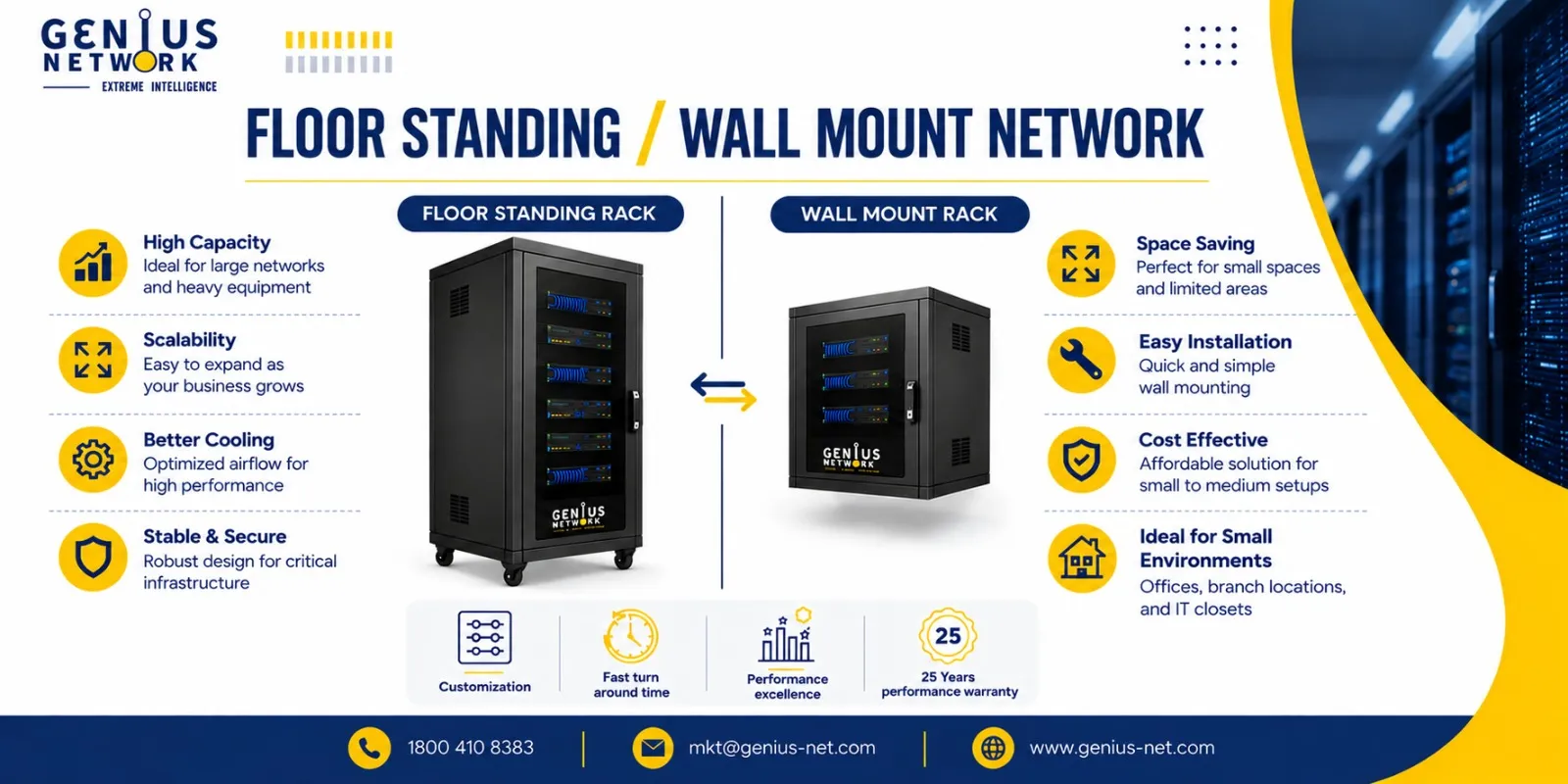
Choosing the right network rack is an important part of building a reliable, organised and scalable IT infrastructure. The selection should be based on the network architecture, equipment requirements, available space and future expansion plans. Two commonly used options are floor standing racks and wall mount racks, and each serves a different purpose within a structured network.
Floor standing network racks are best suited for locations where higher equipment capacity, centralised connectivity and future scalability are required. They can accommodate multiple network switches, patch panels, fiber enclosures, cable managers, servers, PDUs and other rack mounted equipment.
These racks are particularly suitable for hub rooms, server rooms and data centre rooms, where multiple network connections converge and the network may need to expand in the future. Their larger capacity also provides greater flexibility for organised cable management, equipment access and future additions.
For a growing network, selecting an appropriately sized floor standing rack at the initial stage can provide the space required for future expansion without major infrastructure changes.
Understanding Wall Mount Network Racks
Wall mount network racks are designed for network distribution where compact installation and efficient use of space are important. They are particularly suitable for distributing connectivity across different floors, departments, branch locations or specific areas of a building.
In a typical star topology, the central or distribution point can connect to smaller network distribution points located across different floors. In such applications, a wall mount rack can be an effective fit for housing switches, patch panels, fiber termination units and other compact networking equipment at the distribution end.
Wall mount racks are therefore well suited for floor wise network distribution, especially where equipment requirements are moderate and dedicated floor space is limited.
Choosing the Right Rack for Your Network
There is no single rack that is ideal for every application. The right 19 inch network rack should be selected according to the role it plays within the overall network infrastructure.
For a central hub room, server room or data centre where multiple connections converge and future expansion is expected, a floor standing network rack is generally the better choice. For floor wise distribution or local connectivity points in a star topology, a wall mount network rack can provide a compact and efficient solution.
Rack depth, height, equipment quantity, cable density, ventilation, accessibility and future expansion should also be considered before making the final selection.
Build a Scalable Network Infrastructure
A network rack is more than an enclosure for networking equipment. It plays an important role in maintaining organised connectivity, effective cable management and easier network maintenance.
By selecting floor standing racks for centralised infrastructure and wall mount racks for appropriate distribution requirements, organisations can create a structured, scalable and efficient network environment.
The right rack is not about choosing the bigger option. It is about choosing the right rack for the right network requirement.