Blog
Fiber vs Copper: Selecting the Right Infrastructure for Modern Networks
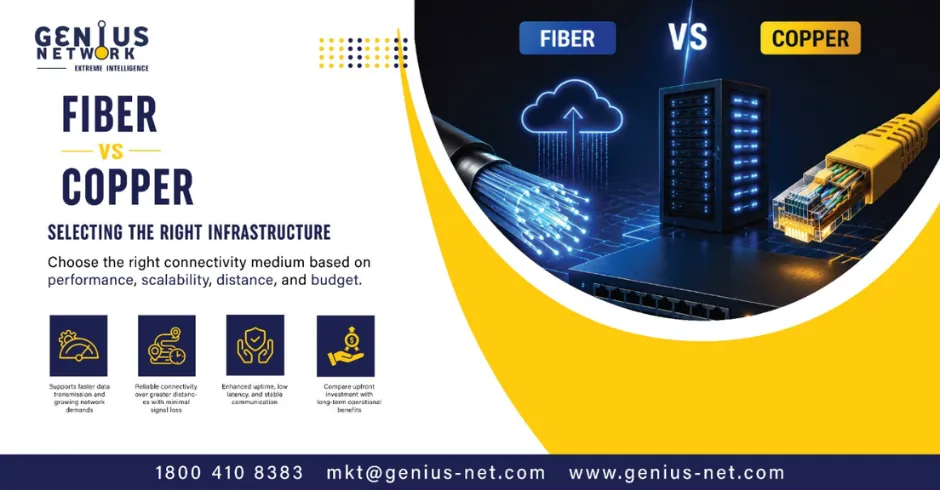
As enterprise networks continue to evolve with 10G, 25G, 40G, 100G, 400G, and AI-driven workloads, selecting the appropriate physical media has become a strategic design decision rather than simply a cabling choice. Network architects and ICT consultants must evaluate bandwidth, transmission distance, latency, electromagnetic interference (EMI), power delivery, scalability, and total cost of ownership (TCO) before deciding between fiber optic cabling and copper structured cabling.
While both technologies remain essential in modern infrastructure, their optimal applications differ significantly.
Understanding the Technology
Copper cabling transmits electrical signals through twisted-pair conductors, making it ideal for horizontal cabling and Power over Ethernet (PoE) applications. Standards such as Category 6, Category 6A, and Category 8 support high-speed Ethernet for enterprise and data center environments.
Fiber optic cabling, on the other hand, transmits data as pulses of light through glass fibers, delivering significantly higher bandwidth, longer transmission distances, and complete immunity to electromagnetic interference. It is the preferred medium for backbone networks, campus connectivity, ISP infrastructure, telecom networks, and hyperscale data centres.
Performance Comparison
When evaluating infrastructure performance, fiber provides clear advantages in bandwidth scalability and transmission distance. Single Mode Fiber (OS2) supports long-distance connectivity extending several kilometers, while Multimode Fiber (OM4/OM5) efficiently supports high-speed data center applications.
Copper remains highly effective for access-layer connectivity where cable runs remain within the standard 100-meter Ethernet limitation.
|
Parameter
|
Fiber Optic Cabling
|
Copper Cabling
|
|---|---|---|
|
Maximum Distance
|
Up to several kilometers
|
100 meters
|
|
Bandwidth
|
10G to 800G+
|
1G to 40G (Category dependent)
|
|
EMI Immunity
|
Complete
|
Susceptible to interference
|
|
Latency
|
Extremely Low
|
Low
|
|
PoE Support
|
No
|
Yes
|
|
Cable Size
|
Smaller & lighter
|
Larger bundle diameter
|
|
Future Scalability
|
Excellent
|
Moderate
|
Infrastructure Selection by Application
The selection should always align with network architecture and operational requirements.Choose Copper When:
- Deploying office LAN infrastructure
- Supporting IP cameras, Wireless Access Points, and VoIP devices
- Implementing PoE and PoE++ powered networks
- Cost optimization is a primary consideration
- Horizontal cabling remains within 100 meters
Choose Fiber When:
- Building campus backbone networks
- Connecting multiple buildings
- Designing hyperscale or enterprise data centers
- Supporting 40G, 100G, 400G, and future 800G Ethernet
- Deploying ISP and telecom infrastructure
- High EMI environments require interference-free communication
Cost Considerations
Although fiber infrastructure typically involves a higher initial investment in optics and termination, it offers a significantly longer lifecycle with greater scalability. As network bandwidth requirements continue to increase, fiber minimizes future replacement costs and supports seamless migration to next-generation Ethernet standards.
Copper infrastructure generally provides a lower upfront deployment cost and remains the preferred solution for endpoint connectivity where PoE capability is essential.
From a long-term engineering perspective, Total Cost of Ownership (TCO) often favors fiber for backbone infrastructure, while copper continues to deliver excellent value for access networks.
Consultant Recommendation
Rather than viewing Fiber and Copper as competing technologies, successful network designs leverage both.
A well-designed structured cabling system typically consists of:
- Fiber optic backbone connecting buildings, server rooms, and core switches
- Copper horizontal cabling connecting end-user devices, access switches, wireless access points, IP surveillance, and IoT infrastructure
This hybrid architecture delivers the ideal balance of performance, flexibility, scalability, and investment protection while complying with TIA-568, ISO/IEC 11801, and IEEE Ethernet standards.
Conclusion
Selecting the appropriate transmission medium should be driven by network performance objectives, bandwidth growth, transmission distance, application requirements, and lifecycle cost analysis. Organizations planning for AI, cloud computing, high-density Wi-Fi, and next-generation data centres should invest in a structured cabling strategy that combines the strengths of both fiber and copper technologies.
With a comprehensive portfolio of Fiber Optic Solutions, MPO/MTP Systems, Category 6, Category 6A, Category 8 Cabling, Patch Panels, and Structured Cabling Components, Genius Network enables consultants, system integrators, ISPs, telecom operators, and enterprise customers to build reliable, standards-compliant, and future-ready network infrastructure.
Recent Posts
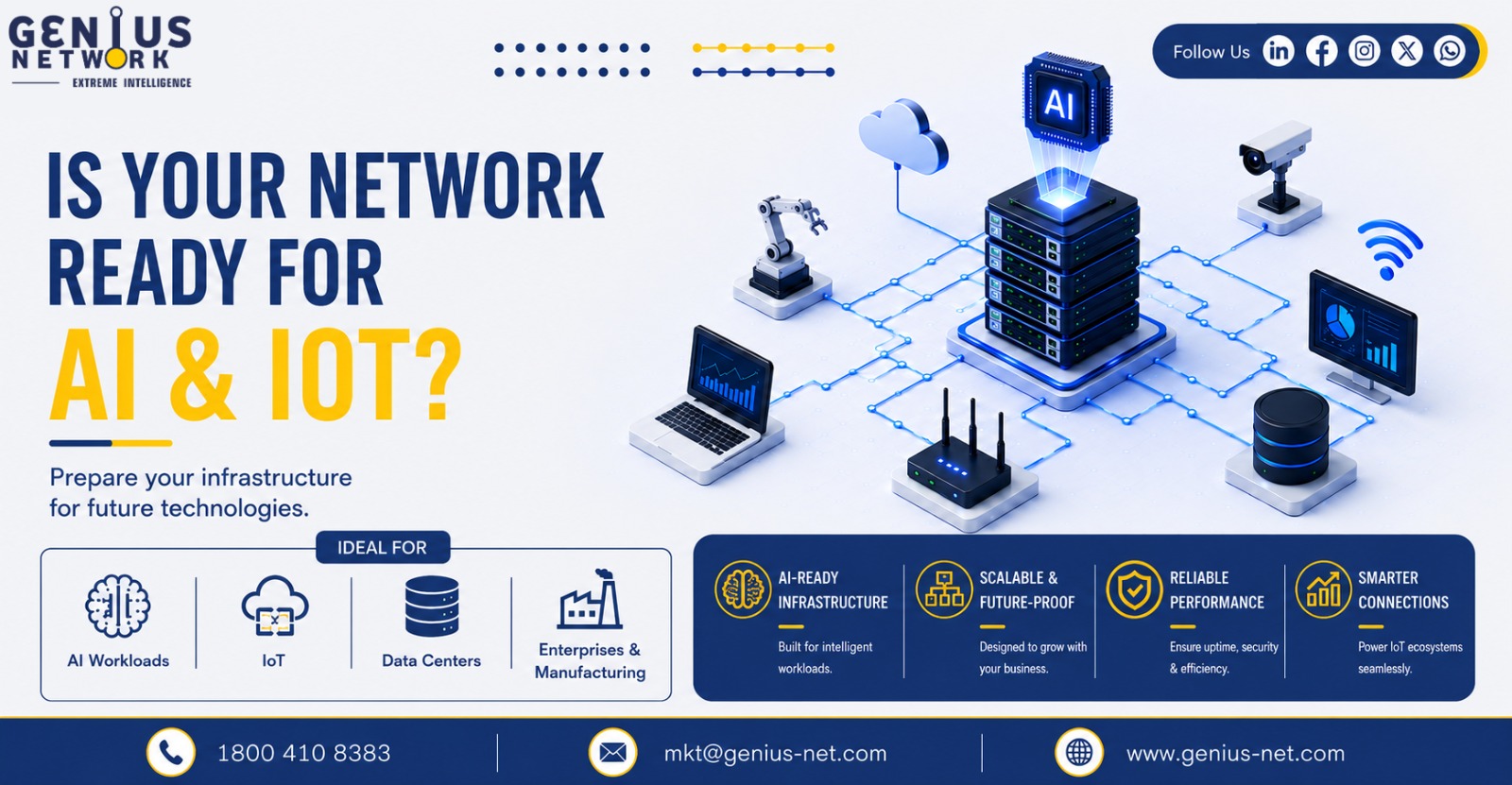
Is Your Network Ready for AI and IoT?
July 14, 2026

The Hidden Cost of Network Downtime
July 6, 2026