5 Checks Before Choosing a Structured Cabling Solution
In today’s digitally connected world, a reliable network infrastructure is essential for business continuity, communication and operational efficiency. Whether it is a corporate office, manufacturing facility, educational campus or data centre, structured cabling forms the foundation of seamless network connectivity.
Choosing the right structured cabling solution is a long term investment. A well designed cabling infrastructure supports current network requirements while providing the flexibility to accommodate future technological developments.
Before selecting a structured cabling system, here are five important factors every System Integrator, ELV Consultant and IT Infrastructure Manager should consider.
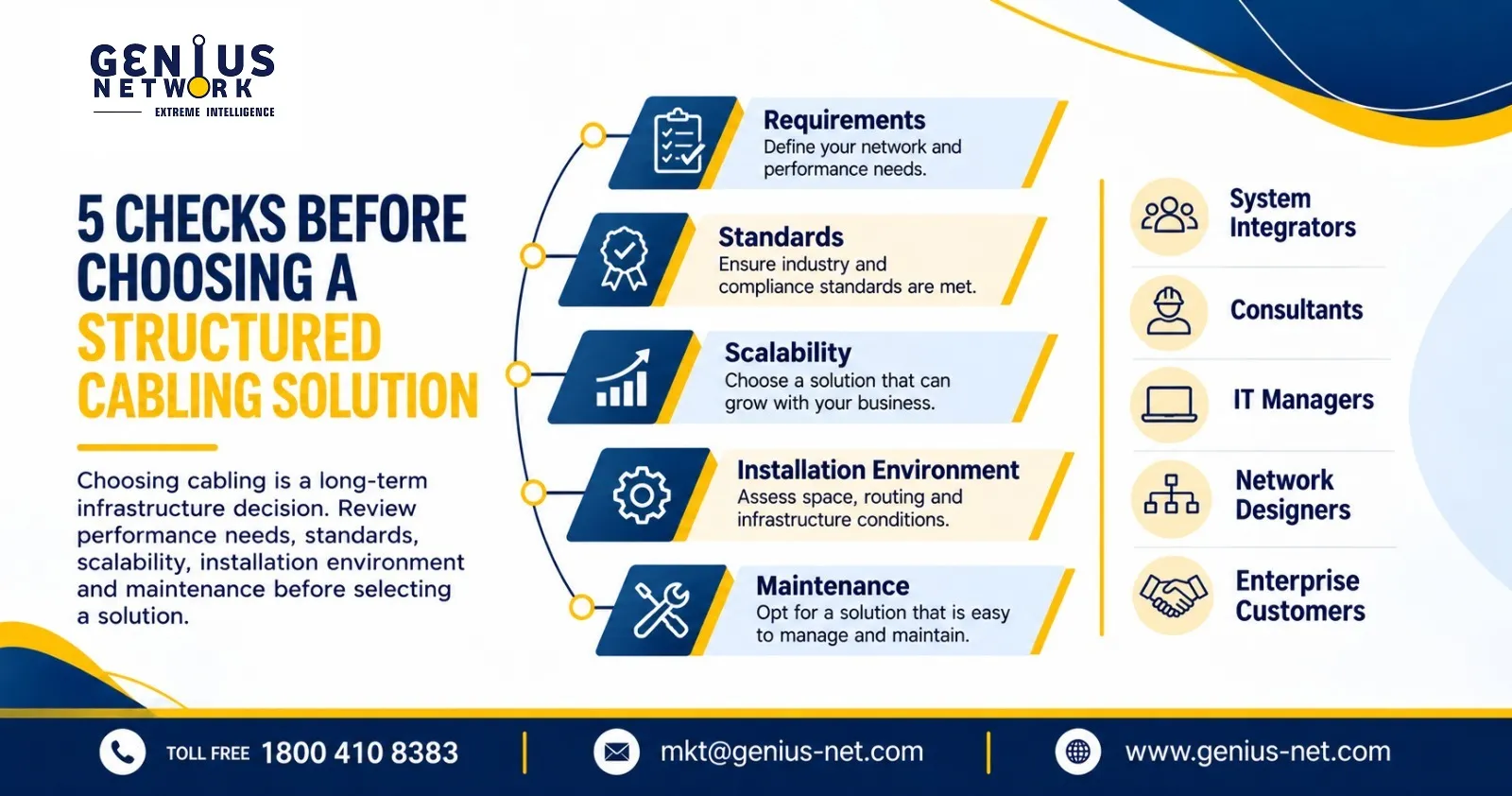
1. Understand Your Network Requirements
Every organisation has different connectivity requirements. Before selecting network cabling products, evaluate the number of users, connected devices, bandwidth requirements and applications that the infrastructure must support.
Consider the need for copper cabling, fibre optic connectivity, network racks and connectivity accessories. Understanding current requirements and anticipated network expansion helps determine the right cabling architecture.
2. Check Industry Standards and Compliance
Industry standards play a vital role in ensuring reliable network performance and interoperability. Ensure that your structured cabling solution aligns with relevant standards such as ANSI/TIA and ISO/IEC 11801.
Evaluate product specifications, testing procedures, certifications and warranty provisions before making a selection. Standards compliant infrastructure helps ensure consistency, reliability and long term performance.
3. Evaluate Scalability and Future Readiness
Network requirements continue to evolve with increasing data consumption, cloud applications, connected devices and digital transformation.
A scalable network infrastructure should accommodate additional network points, higher bandwidth requirements and future fibre connectivity without requiring major infrastructure modifications.
Selecting flexible structured cabling solutions today can help organisations manage tomorrow’s connectivity demands more efficiently.
4. Consider the Installation Environment
The installation environment directly influences cable selection and infrastructure design. Corporate offices, industrial facilities and data centres have different environmental and operational requirements.
Evaluate temperature conditions, electromagnetic interference, cable routing pathways, installation space and rack organisation. Selecting suitable copper and fibre optic cabling products according to the application helps establish reliable connectivity.
5. Prioritise Maintenance and Documentation
A structured cabling project does not end with installation. Proper testing, labelling, documentation and maintenance are essential for long term network performance.
Ensure that cable certification, port identification, routing documentation and infrastructure records are maintained. An organised cabling system simplifies troubleshooting, reduces maintenance complexity and supports future network expansion.
Building a Strong Foundation for Tomorrow
Selecting the right structured cabling solution requires careful consideration of performance, compliance, scalability, installation conditions and maintenance.
For System Integrators, Consultants and Enterprise Customers, making informed decisions at the planning stage helps create a reliable and future ready network infrastructure.
At Genius Network, we are committed to delivering quality passive networking and structured cabling solutions that empower businesses to build reliable, scalable and intelligent connectivity infrastructure.